

Bold colors transform a Boston Harbor waterfront home with a modern coastal palette inspired by Key West style and 25 years of client collaboration.
— Insights
waterfront, Renovation
A Study in Contemporary Residential Architecture: From Compartmentalized Colonial to Open-Concept Entertaining

How do you transform a warren of small, disconnected rooms into flowing entertaining spaces while maintaining the privacy modern families need? At this waterfront property in Quincy, Massachusetts, structural discovery and strategic engineering unlocked an open-concept transformation by architecture firm RUHL | JAHNES that honored the clients’ vision while solving the compartmentalized challenges inherent in Colonial-era floor plans.
The Technicolor Dreamhouse demonstrates how contemporary residential architecture can address the limitations of historic home layouts through careful structural work, thoughtful spatial planning, and design strategies that make spaces feel expansive without adding square footage.
The Challenge of the Divided Colonial
The original floor plan epitomized the compartmentalized Colonial typology: multiple small rooms separated by load-bearing walls with narrow openings, excessive hallway circulation, and limited natural light penetration. While the property offered exceptional Boston Harbor views, interior walls blocked sight lines and prevented the family from capitalizing on the home’s greatest asset.
The clients purchased the property as a fixer-upper with a clear vision. Having previously lived in a Boston loft, they wanted to recreate that sense of openness and multi-functional flow in a waterfront setting. Daily living felt cramped. Entertaining was claustrophobic. The existing layout simply couldn’t accommodate the way they wished to use their home.
Structural Discovery in Home Renovation: When Fire Damage Becomes Opportunity
Exploratory demolition revealed prior fire damage that had compromised the second floor framing. What initially appeared as a significant constraint became the project’s defining opportunity. The entire second floor required structural replacement, which allowed the design team to approach the home’s structural systems with unusual flexibility.
By concealing new structural beams within the rebuilt second floor, load-bearing walls on the first floor could be eliminated entirely. This structural engineering solution transformed the lower level from a series of disconnected rooms into continuous, flowing spaces. The constraint became the catalyst for open living.
Creating Flow: The New Open Layout
Living, Dining, and Kitchen as One Continuous Space
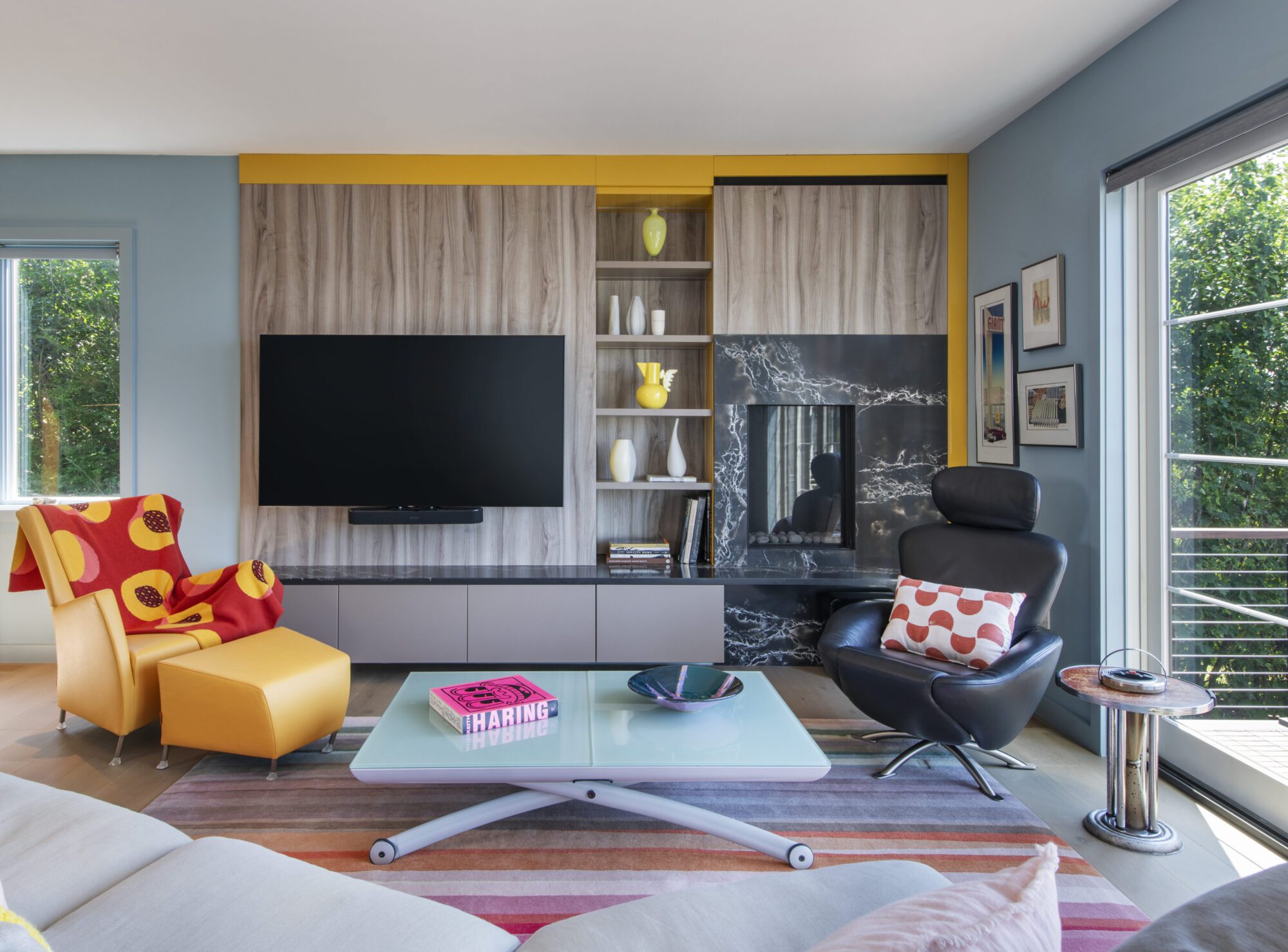
One large, freely flowing space now replaces the warren of small rooms. Separate seating areas define distinct zones for living, dining, and kitchen functions without requiring physical barriers. Unified finishes throughout create visual continuity: the same materials appear in kitchen and living spaces, reinforcing the sense of cohesion.
A small fireplace anchors the living area within the open plan, providing a focal point that works for both intimate evenings and larger gatherings. “The trick is to design this kind of open, flowing space so that it feels just as comfortable for big parties or for 2 people,” explains architect Will Ruhl. The layout accommodates both family dinners and large-scale entertaining because zones are defined by furniture arrangement and function rather than walls.

The Guest Suite Strategy: Creating Privacy and Acoustic Separation
Open-concept living presents particular challenges when privacy and acoustic separation are essential. For this project, the clients required a ground-floor guest suite for elderly relatives who needed accessibility without feeling isolated from family life. The solution draws inspiration from hotel suite design: a small vestibule with multiple doors creates a buffer zone between the guest area and the main living spaces.
The guest suite sits behind a wall of floor-to-ceiling cabinetry, visually connected to the open plan but acoustically separate. Reconfiguring the basement stair allowed this ground-floor suite to fit within the existing footprint, demonstrating how structural problem-solving can improve functional design. The result balances openness with practical privacy needs, a key tension in contemporary residential architecture.
Natural Light and Open Air: Staircase Reconfiguration
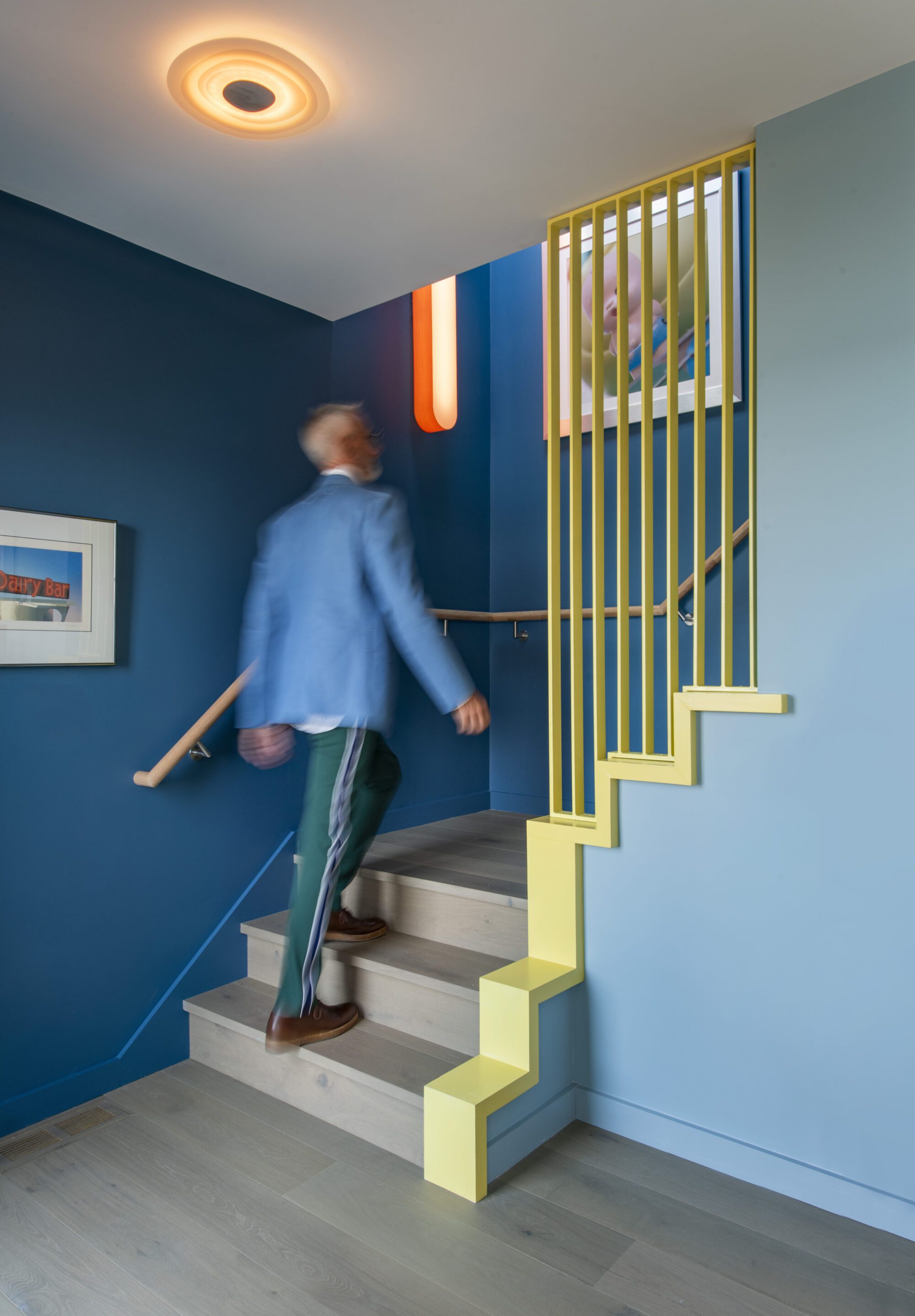
The original circulation was convoluted: an up-down-up sequence with a separate z-shaped basement stair that consumed valuable floor area. The new integrated design tucks the basement stair beneath the main stair through structural reframing, consolidating vertical circulation and opening floor space.
Removing one wall and installing a custom steel screen opens the stairwell to the living spaces, increasing visual connection while maintaining spatial definition. A new skylight floods the stairwell with natural light, enhancing the perception of space throughout the home. This partially-open stair strategy demonstrates how maintaining some definition while increasing light and views can make compact spaces feel substantially larger.
Subtle Strategies for Making Small Spaces Feel Expansive
Beyond structural wall removal, smaller design decisions compound the sense of openness. Floor-to-ceiling cabinetry walls expand perceptual space around corners, eliminating the visual clutter that makes rooms feel cramped. Sleek, flat-paneled built-ins maintain clean lines throughout, avoiding the visual weight of traditional cabinetry.
Material choices amplify these effects. Frosted glass cabinet fronts and glossy porcelain surfaces reflect light, multiplying the impact of natural illumination. These choices enhance openness without requiring structural changes, demonstrating how contemporary residential architecture uses both major interventions and subtle refinements to transform spatial experience.
Connecting to Boston Harbor: Sliding Doors and Oversized Bay Windows
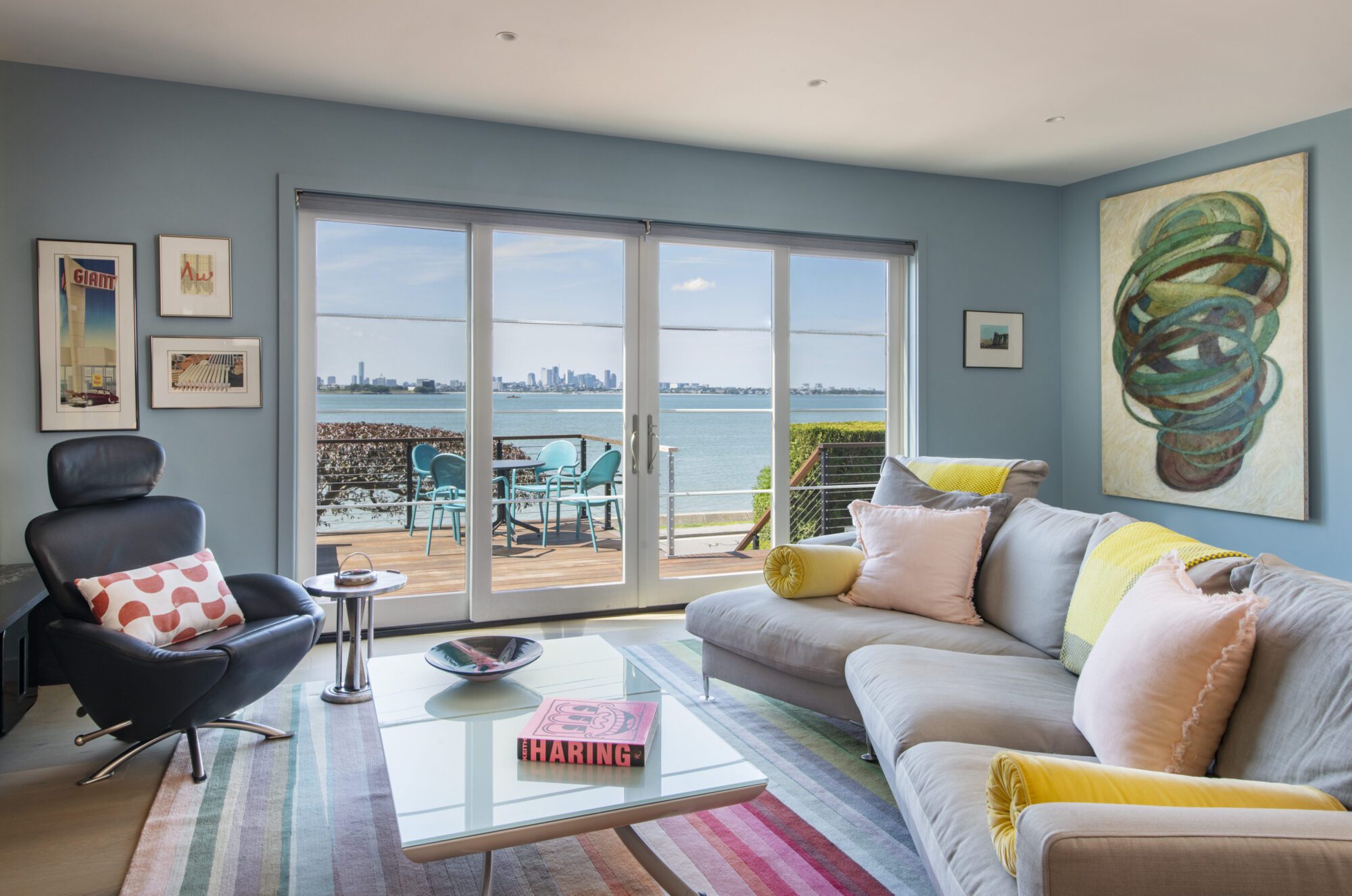
Large-scale glass openings frame the Boston Harbor views that drew the client to this property. Twelve-foot sliding doors enable seamless indoor-outdoor entertaining flow for large parties, while oversized bay windows bring water views deep into the interior living spaces. These openings work in concert with the interior openness: views provide visual interest and focal points that prevent large, flowing spaces from feeling empty or undefined.
The harbor view functions as a design anchor, creating an intimate atmosphere even within the expansive open plan. Whether hosting two people for a quiet evening by the fire or fifty guests circulating through the space, the water serves as a consistent point of orientation and connection to landscape.
Practical Considerations in Contemporary Residential Architecture
Acoustics, Climate Control, and Visual Balance
The complete gut renovation allowed new HVAC, plumbing, and electrical systems to be optimized for the open layout from the outset. Acoustic insulation between floors and between spaces became critical for maintaining privacy and comfort. Abundant soft furnishings help control noise during large gatherings, preventing the echo that can plague open plans with hard surfaces.
Managing visual clutter in large-scale spaces requires deliberate curation. The client’s twenty-five-year relationship with the firm informed furniture selection and spatial planning, ensuring that pieces work at the appropriate scale. Open-concept living demands this kind of intentionality: too little furniture and spaces feel empty; too much and the space becomes muddled.
From Intimate Evenings to Large-Scale Entertaining: Making Open-Concept Work for Every Occasion
The fundamental design challenge was creating a space that feels comfortable whether occupied by two people or fifty guests. The solution lies in multiple seating areas and defined zones within the overall openness. Harbor views provide a focal point for intimate moments by the fire, while the ability to flow around corners prevents party claustrophobia as guests move freely between conversation areas.
No square footage was added to the original structure, yet the spatial experience expanded dramatically through design strategy alone. This underscores a core principle of contemporary residential architecture: transformation often comes from reorganization and strategic removal rather than addition.
When To Pursue Contemporary Transformation in a Historic Home Renovation
Debate over historic home restoration often centers on the question of when to pursue contemporary transformation over period-accurate restoration. In this case, the original home lacked historic architectural charm. Previous owners had stripped period details, leaving a structure without significant heritage value. The true assets were the waterfront location and Boston Harbor views, not the character of the home.
The design approach focused on maximizing views externally while removing unnecessary divisions internally. Open-concept felt appropriate rather than forced because the architecture supported contemporary living without sacrificing meaningful historic elements. When a home’s value lies in location rather than architectural heritage, contemporary transformation can be the most honest response.
From A Warren of Rooms to Waterfront Loft in Quincy, MA
The Technicolor Dreamhouse realizes its goal of recreating the openness of the client’s previous Boston loft in a waterfront setting. This open-concept transformation by RUHL | JAHNES demonstrates how Colonial structures can serve modern lifestyles when structural challenges are approached as opportunities through careful engineering and planning.
The result is a set of multi-functional entertaining spaces that balance openness with practical privacy needs. Open-concept serves as an intentional design strategy rather than a forced trend when properly executed with attention to structure, circulation, acoustic separation, and the subtle details that make compact spaces feel expansive.