

RUHL | JAHNES shares lessons about working with existing structures, hidden damage, and meeting modern codes while preserving architectural character.
— Insights
houses
From Gathering to Retreat: Home Design for Hosting and Sanctuary
Creating a Home that Balances Social Hubs with Private Nooks
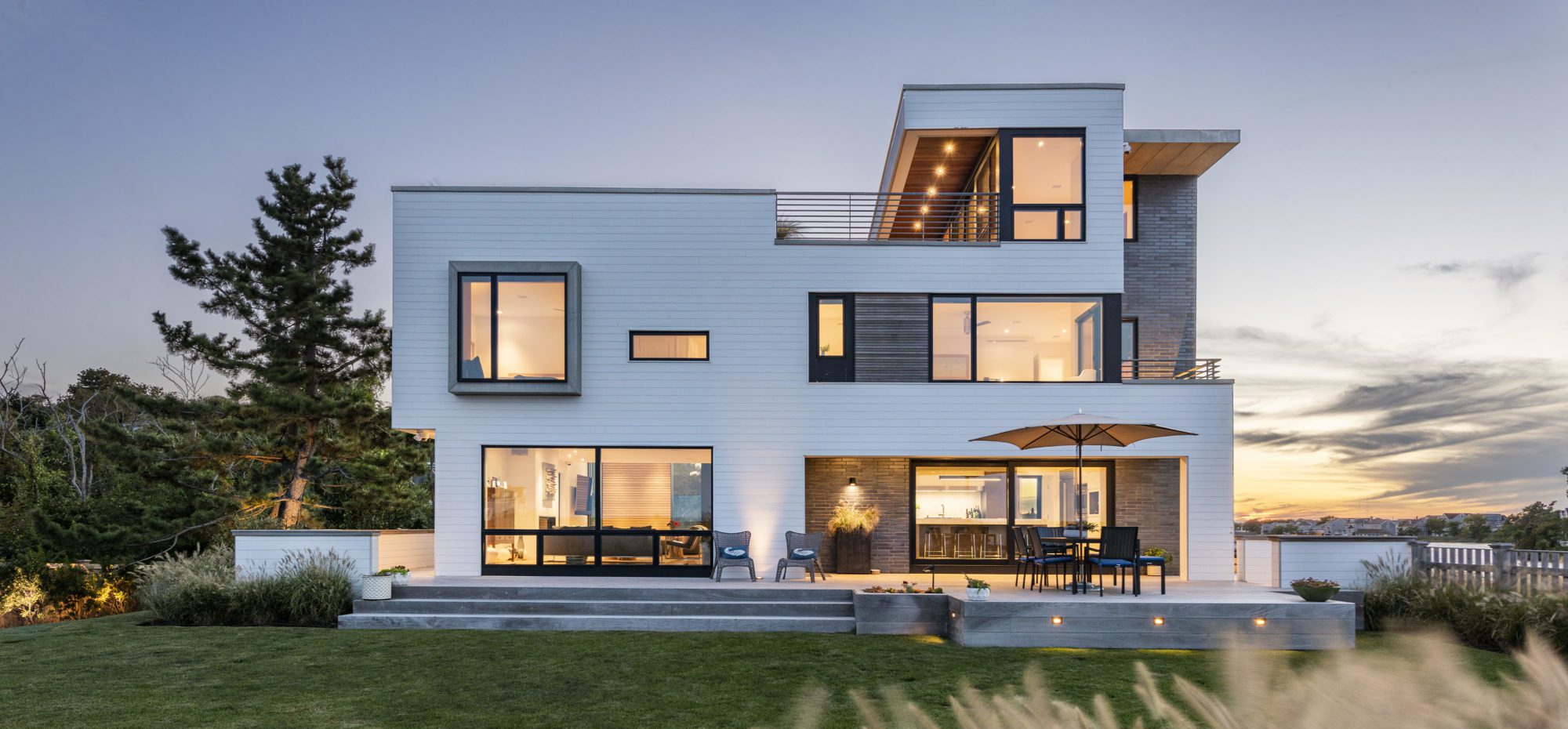
When the clients approached architecture firm RUHL | JAHNES with their vision for the Black Rock Beach House, they presented a paradox: a home that could accommodate dozens of guests for dance parties while remaining comfortable for just two people and their dog. Designing for both large gatherings and intimate daily living in the same spaces requires strategic spatial planning that goes beyond simple square footage. The challenge intensified because the project worked within an existing footprint, meaning solutions had to emerge from reorganization and reorientation rather than pure expansion.
Custom features underscored the serious commitment to entertaining: a turntable DJ station was integrated directly into the living space for regular dance parties. Yet this same space needed to feel welcoming on quiet evenings when the house was empty except for the couple. The solution lay in creating spatial hierarchies and circulation strategies that allow the home to function at multiple scales simultaneously—public and private, social and intimate, all within the same architectural framework.
Spatial Flow: Creating Natural Transitions Between Public and Private Spaces in the Home
Ground Floor as Open Canvas
The ground floor was designed as one large, open, free-flowing space, but with inherent flexibility built into its organization. The plan reads as four overlapping rectangles, a geometric strategy that creates natural quieter corners within the larger openness. Smaller gathering spaces within this area remain comfortable for just two people, avoiding the echoing emptiness that can plague open-plan homes when sparsely occupied. A semi-hidden half bath adds functional separation while creating additional spatial differentiation.
Circulation and Entry Strategies
The approach builds on lessons from other projects in the RUHL | JAHNES portfolio where indoor-outdoor connection transforms how spaces function across seasons and occasions. Here, that principle extends to the relationship between social and private zones. Circulation strategies reinforce these transitions: a traditional front door for everyday comings and goings, supplemented by ten-foot-wide kitchen sliding glass doors for casual party flow. Guests arriving for a gathering experience the house differently than residents do on an ordinary Tuesday evening, and the architecture accommodates both patterns seamlessly.
Acoustic and Visual Privacy Solutions in Home Design
Privacy in an open-plan home requires more than floor plan strategy, it demands attention to sensory experience. Floors between levels are heavily insulated to provide acoustic separation between bedrooms and the living spaces below, ensuring that parties don't compromise rest for those who retreat upstairs. Visual privacy relies primarily on door placement as a clarification of zones: doors signal private versus public territory in ways that open passages cannot. The existing house lacked adequate separation between primary and guest bedrooms, requiring wall modifications and additional bathrooms to establish privacy.
The design draws on the firm's experience with loft projects, where creating homes that accommodate parties while remaining comfortable for two is a consistent challenge. Roof deck access was redesigned to be straightforward without interfering with bedroom privacy, which required careful coordination of stair placement and door locations. Added windows within the stair area redirect views toward the tidal pond rather than inward toward bedrooms, maintaining privacy while enhancing the spatial experience of circulation. Acoustic, visual, and circulatory layers of consideration work together to establish genuine privacy despite the home's openness.
Social Hubs: Designing Residential Spaces That Invite Gathering
The Cantilevered Bay Window as Social Anchor
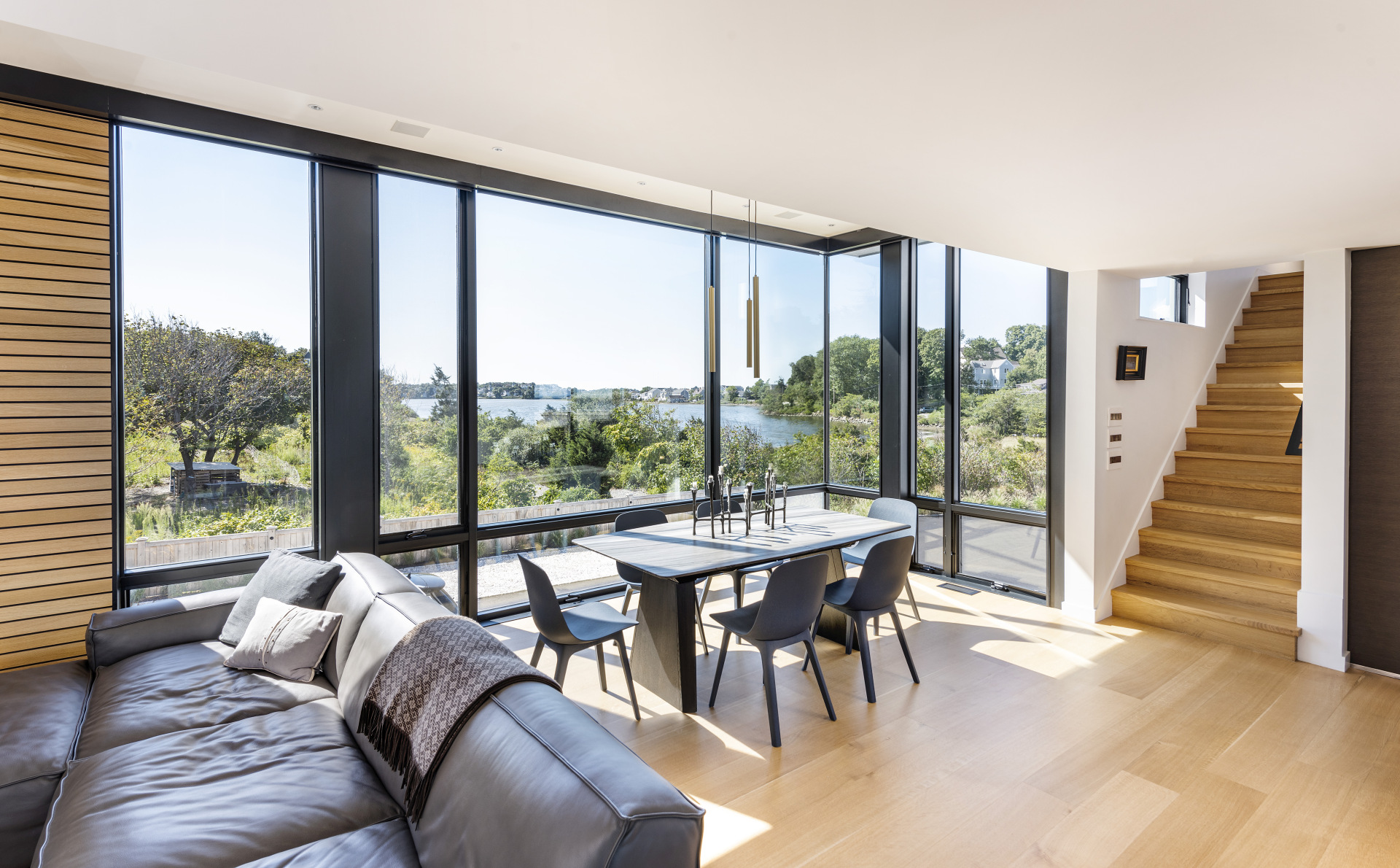
The large cantilevered bay window addition does more than expand square footage, it creates a space that feels simultaneously connected to and separate from the main living area. A raised ceiling height within this volume establishes its distinct character. Each gathering area throughout the home is reinforced through furniture placement, with unique views and window configurations that give each zone its own identity. The dining bay window frames previously blocked views of the tidal pond, transforming dining from a functional necessity into an experiential highlight. This new addition creates a distinct social zone without sacrificing the connectivity that makes open-plan living work.
The strategy extends beyond a single dramatic gesture. Throughout the main living level, spatial definition emerges from the interplay of ceiling heights, window placements, and sightlines. Rather than relying on walls to separate functions, the architecture uses volumetric variation and strategic views to establish territory. The result is a space that can be read as unified or subdivided depending on how it's used, whether gathering dozens of guests or hosting an intimate dinner for four.
Kitchen Design and Entertaining
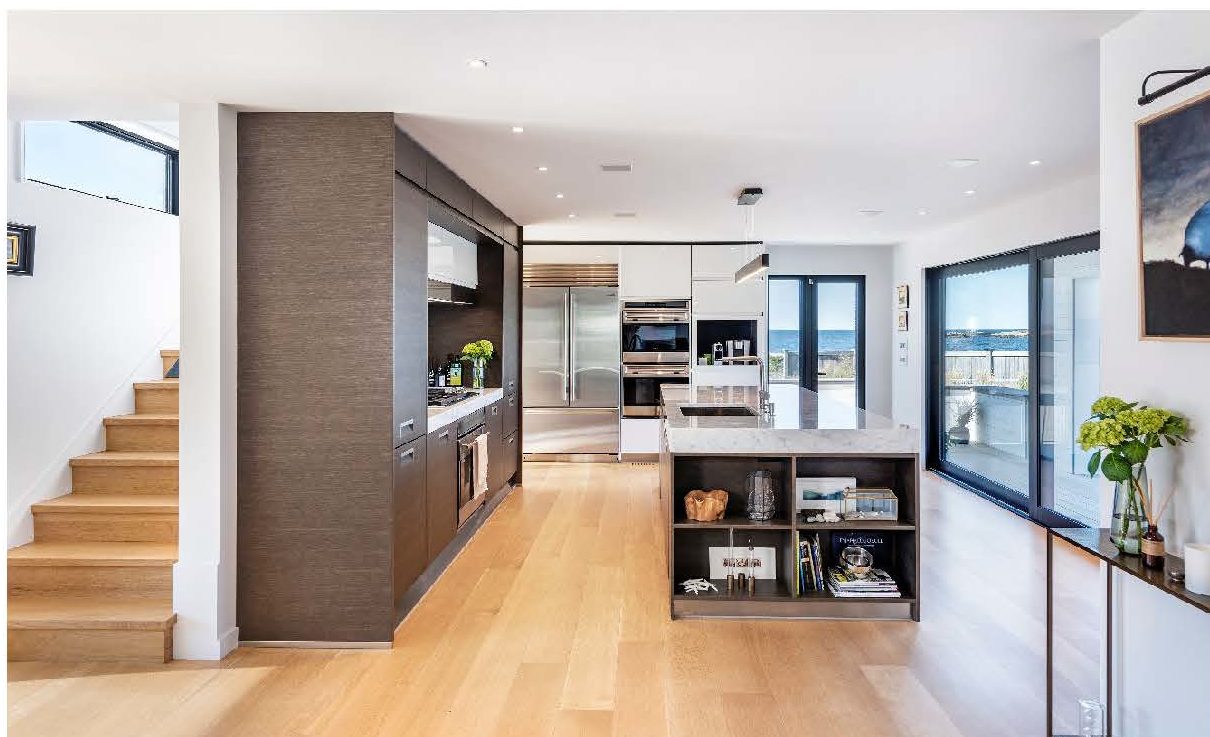
The kitchen sits at the social center of the home, connecting all major spaces and serving as the natural gathering point during parties. An oversized island provides both surface area and psychological separation. Friends can gather around while the hosts work without guests being in the active cooking zone. Details throughout feel more like living space than utilitarian kitchen, maintaining high functionality while avoiding commercial aesthetics. The direct connection to outdoor decks through massive sliding doors enables seamless indoor-outdoor entertaining, expanding capacity without adding interior square footage.
Opening the kitchen to the rest of the living space while maintaining some spatial definition required careful balance. Too much separation would undermine the social function; too little would make the kitchen feel exposed during everyday use. The solution involved working with furniture placement, ceiling articulation, and the oversized island to create permeable boundaries so that the kitchen feels part of the larger whole during gatherings but maintains its own identity during daily routines.
Five-Zone Living: Multiple Functional Living Room Design
The main living space is organized into five distinct furniture zones, each serving specific functions regardless of how many people occupy the house:
- A large sitting area with a fireplace and ocean views anchors conversation and relaxation.
- A TV watching area tucks into a back corner for casual entertainment.
- The dining area in the new bay window offers dramatic pond views.
- The kitchen maintains its dual identity as both workspace and social hub.
- A dance zone occupies the center of the space, accommodating the integrated DJ station and party flow.
This multi-zone approach prevents the common pitfall of open-plan living: spaces that feel either uncomfortably empty or chaotically full depending on occupancy. By establishing distinct territories through furniture arrangement and spatial cues rather than walls, the home maintains flexibility while offering clear structure. Each zone works independently or in concert with others, allowing the space to scale up or down depending on use. The clients can use just one corner for a quiet evening or activate all five zones during a gathering, and the architecture supports both patterns equally well.
The Modern Roof Deck: Roof Deck Design for Entertaining
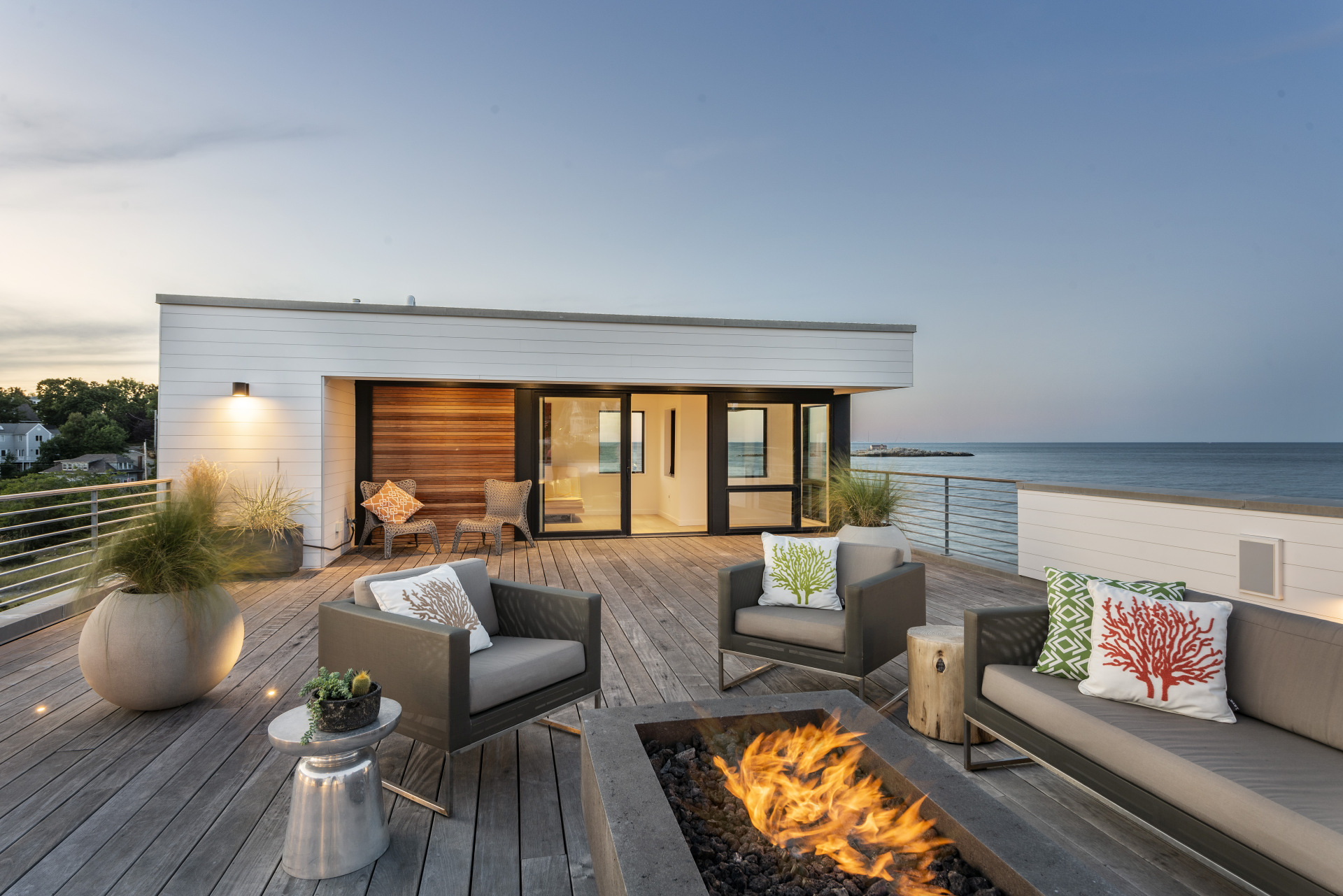
The roof deck exemplifies the dual-function approach at an outdoor scale. Large enough to accommodate dozens of guests, it remains comfortable for just two through strategic furnishing and planter placement. Half the deck sits behind solid parapets for privacy and shelter; the other half features open metal railings for expansive views and visual openness. This differentiation creates adjustable levels of privacy versus openness depending on use: intimate corners for everyday retreat, open expanses for entertaining.
Extending Social Space Outdoors with Indoor-Outdoor Entertaining Areas
Extensive exterior decks throughout the project expand hosting capacity significantly, designed as natural extensions of interior gathering areas rather than separate outdoor rooms. Massive sliding doors enable seamless party flow from inside to outside, effectively doubling usable space during gatherings. Yet these same decks function equally well for morning coffee or evening conversation for two. The connection to the coastal landscape enhances both entertaining and everyday living, providing a backdrop that scales appropriately whether the space hosts two people or twenty.
Private Nooks: Architectural Strategies for Retreat
Guest Bedroom Design: A Reading Window Nook and Ocean Views
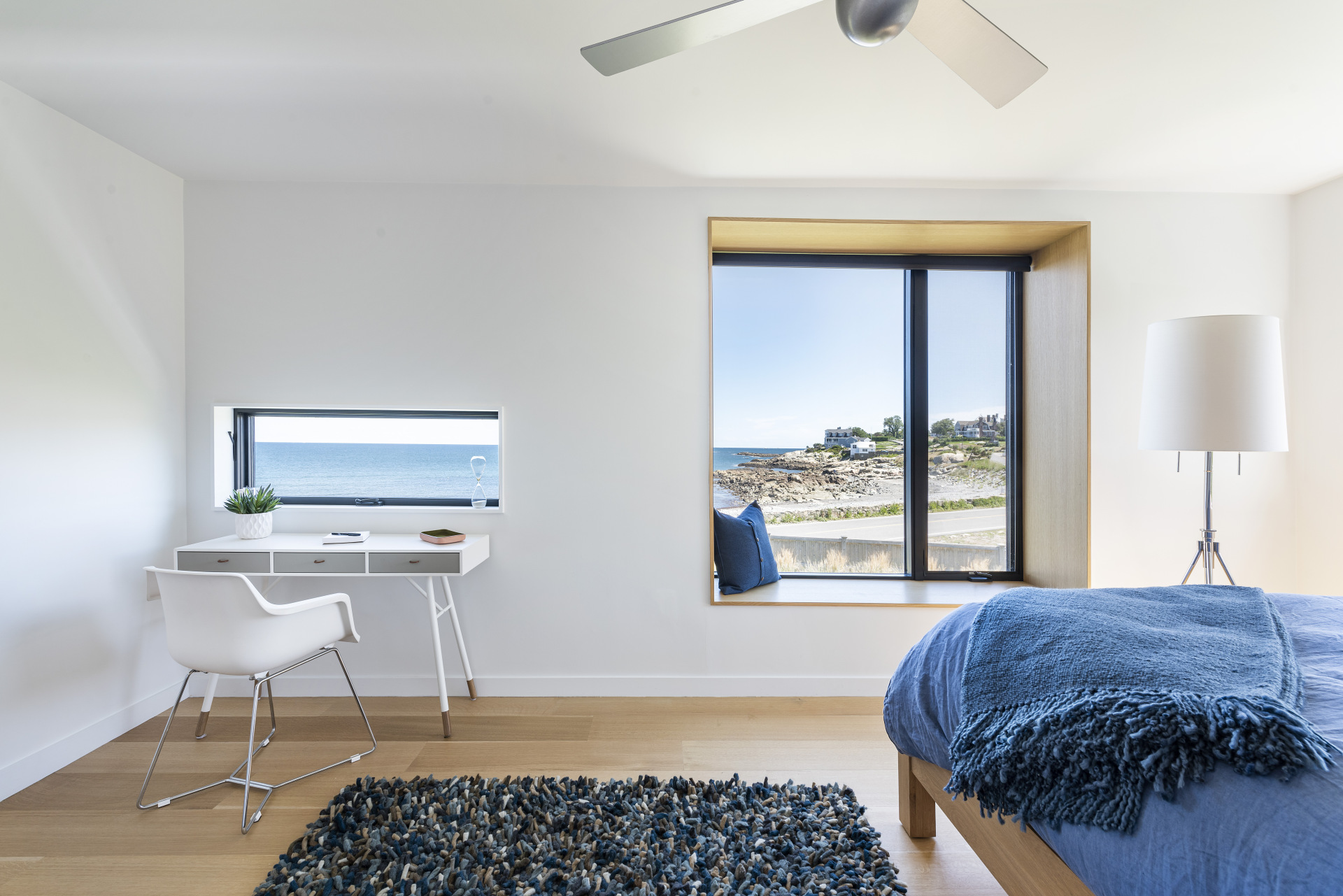
The ocean-facing guest room features an innovative inside-outside bay window: a sitting area that projects beyond the exterior wall while feeling enclosed by solid surfaces. This creates the psychological comfort of enclosure with the experiential benefit of outward orientation. A low window at desk height provides an additional ocean connection for work or reading, establishing multiple scales of engagement with the landscape. These layered window types and placements create a richness that transforms a simple guest room into a compelling retreat.
The design recognizes that privacy isn't just about separation from other people, it's also about creating spaces that feel protected and contained. The bay window achieves both: physical separation through its projection from the main house volume, and psychological security through its carefully calibrated enclosure. Multiple window types at different heights and orientations ensure that the connection to landscape remains dynamic rather than static, offering different views depending on whether one is standing, sitting, or lying down.
Primary Bedroom: Small Square Footage, Expansive Feel
The primary bedroom demonstrates how modest square footage can feel substantially larger through design strategy. Several overlapping nooks gather around a small private deck for two, each serving different functions while maintaining spatial connectivity. With one corner for reading, another for dressing, a third for relaxing, these differentiated zones create the perception of multiple rooms within a unified space. The private outdoor deck provides retreat space without requiring the owners to share the main roof deck during gatherings, a subtle but important consideration for maintaining sanctuary during social events.
Architectural Deal: A Recessed Window Seat Offers Psychological Retreat
Varied ceiling heights and spatial scales throughout these nooks create moments of refuge within the larger bedroom. Recessed window seats provide a sense of enclosure and psychological safety that makes them feel genuinely distinct from adjacent spaces. Strategic placement ensures these intimate spaces feel separate from public areas even within the home's open-plan framework. The result is a primary suite that offers both openness and privacy, expansion and protection, all calibrated to support how the owners actually live in the space.
Lessons in Flexible Living: Design Principles for Hosting at Home
The Black Rock Beach House builds on the firm's loft design experience, translating principles learned in urban contexts to residential coastal architecture. The clients had seen RUHL | JAHNES's Boston loft design work and sought the same feeling for their beach house: maximum openness balanced with coziness, flexibility that accommodates both crowds and solitude. This represents a continuous learning process informed by project work and travel experiences. The architects regularly stay in boutique hotels worldwide, studying how successful hospitality design creates spaces that feel both expansive and intimate.
Visual inspiration has evolved from print magazines to web-based sources like Instagram, Houzz, and Pinterest, but the core principle remains applicable across projects: designing flexible spaces that work equally well for dozens or two. The pandemic provided an unexpected test of this flexibility as the clients remained at the beach house full-time rather than splitting time with their Boston residence. They found that the home could transform to accommodate a home gym and two office spaces without feeling claustrophobic. This real-world validation confirmed that thoughtful spatial planning creates genuine adaptability.