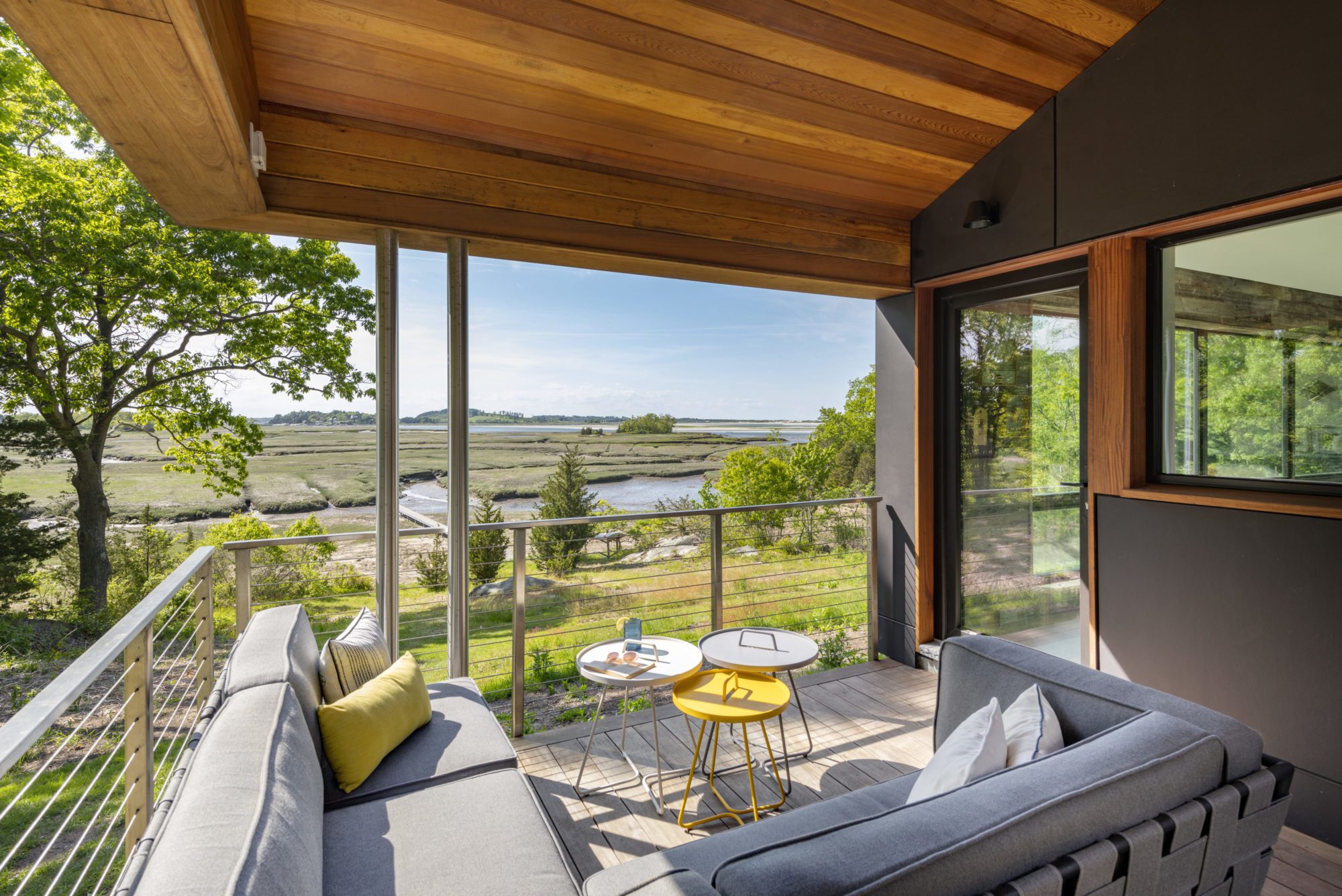
A look at how thoughtful architecture by RUHL | JAHNES balances social hubs with private nooks in a coastal New England home.
— Insights
houses
Beyond Conservation: How Net-Positive Architecture Works in a Sensitive Wetland Environment

When Contemporary Sustainable Architecture Meets Sensitive Ecosystems
Net-positive architecture generates more energy than it consumes, contributing surplus power to the electrical grid while meeting all operational needs. Achieving this performance standard in any context demands careful integration of passive design strategies, active systems, and building envelope optimization. When the site occupies a sensitive wetland environment subject to strict regulatory oversight, the challenge intensifies, requiring architects to simultaneously advance energy performance goals and environmental protection imperatives.
Designed by Massachusetts-based architecture firm RUHL | JAHNES, the Essex Bay House demonstrates that these objectives can support rather than conflict with one another. Through close collaboration with conservation officials, strategic solar orientation, super-insulation, and native landscape design, the project moves beyond the conventional do-less-harm conservation approach. Instead, it establishes a model for architecture that actively contributes positive environmental and energy impacts, proving that technology and ecosystem stewardship advance together when integrated from the beginning of the design process.
Super-Insulated and Solar-Powered in Gloucester, MA
Client-Driven Modern Sustainable Design
The clients of the Essex Bay House arrived with clear sustainability aspirations: a net-zero, super-insulated, solar-powered home that would meet or exceed Energy Star guidelines. This commitment shaped the entire design process from initial concepts through construction documentation, establishing performance benchmarks that the design team worked to exceed. When sustainability goals originate with owners rather than being proposed by architects, projects often achieve higher performance levels because clients understand the value proposition and remain committed through decision points where cost considerations might otherwise compromise systems.
The distinction matters: client-driven sustainability creates different project dynamics than architect-recommended green features. Owners who prioritize energy performance participate more actively in system selections, understand trade-offs between upfront costs and long-term savings, and maintain focus on performance goals throughout construction. This alignment between client values and design objectives enabled the project to achieve net-positive status rather than settling for the less ambitious net-zero target initially proposed.
Defining Net-Zero vs. Net-Positive Architecture
Net-zero architecture consumes only as much energy as it generates annually, achieving balance between demand and production. Net-positive architecture exceeds this threshold, generating more energy than required for building operations and contributing surplus power back to the grid. The Essex Bay House achieves net-positive status through coordinated passive and active strategies that both reduce energy demand and maximize renewable generation.
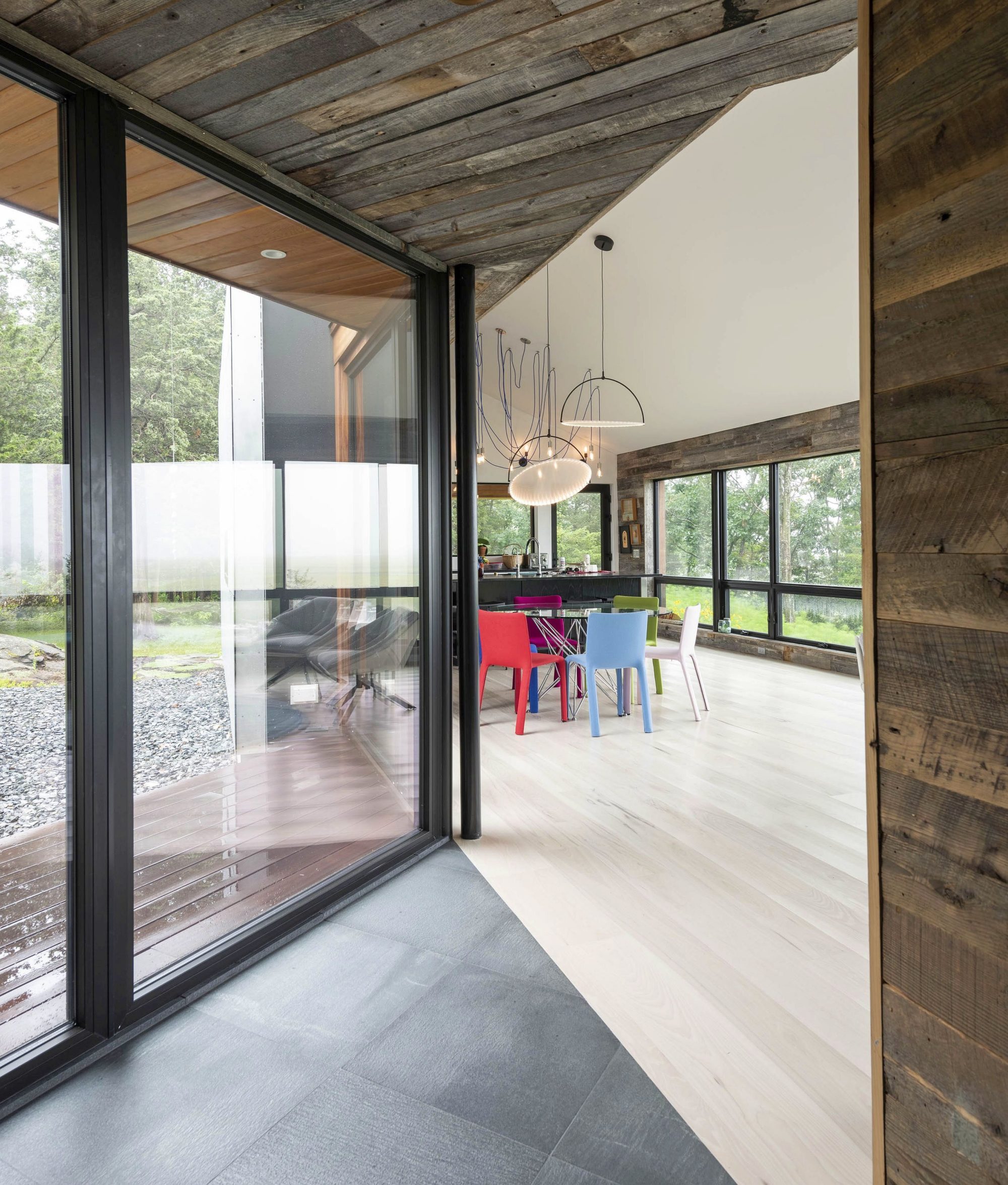
The home generates sufficient power to operate all building systems, charge two electric vehicles, and still contribute excess energy to the electrical grid. This surplus production represents genuine environmental contribution rather than merely neutral impact, transforming the residence from energy consumer to distributed generation asset. The achievement demonstrates that properly designed buildings can serve infrastructure functions beyond simply housing occupants.
Navigating Riverfront Regulations and Conservation Requirements in Wetland Architecture
Close Collaboration with Gloucester Conservation Commission
The design team worked closely with the City of Gloucester Conservation Commission throughout the design process, collaborating with surveyors and engineers to determine precise riverfront setback locations. This coordination ensured the home maximizes Essex Bay views while carefully avoiding harm to protected resource areas. Rather than treating regulatory requirements as obstacles to be minimized, the team engaged them as frameworks that would ultimately improve the project. Regulatory constraints informed rather than hindered the net-positive design strategy. Required setbacks influenced building orientation, which in turn shaped opportunities for solar collection and passive design strategies.
Waterfront Site Advantages Inform Sustainability Strategy in Essex Bay
The site's unique characteristics—proximity to Essex Bay, required setbacks, existing topography—created opportunities for net-positive design that might not have existed elsewhere. Riverfront regulations established building placement that happened to optimize solar orientation, while the wooded lot provided natural screening that allowed larger south-facing roof planes without visual impact from the water. The design team treated these constraints as advantages, using required setbacks and site conditions to inform passive design strategies and solar array sizing. When site characteristics and regulatory requirements align with performance goals, constraints become design assets rather than limitations.
Technologies and Systems for Net-Positive Performance

Strategic Solar Orientation
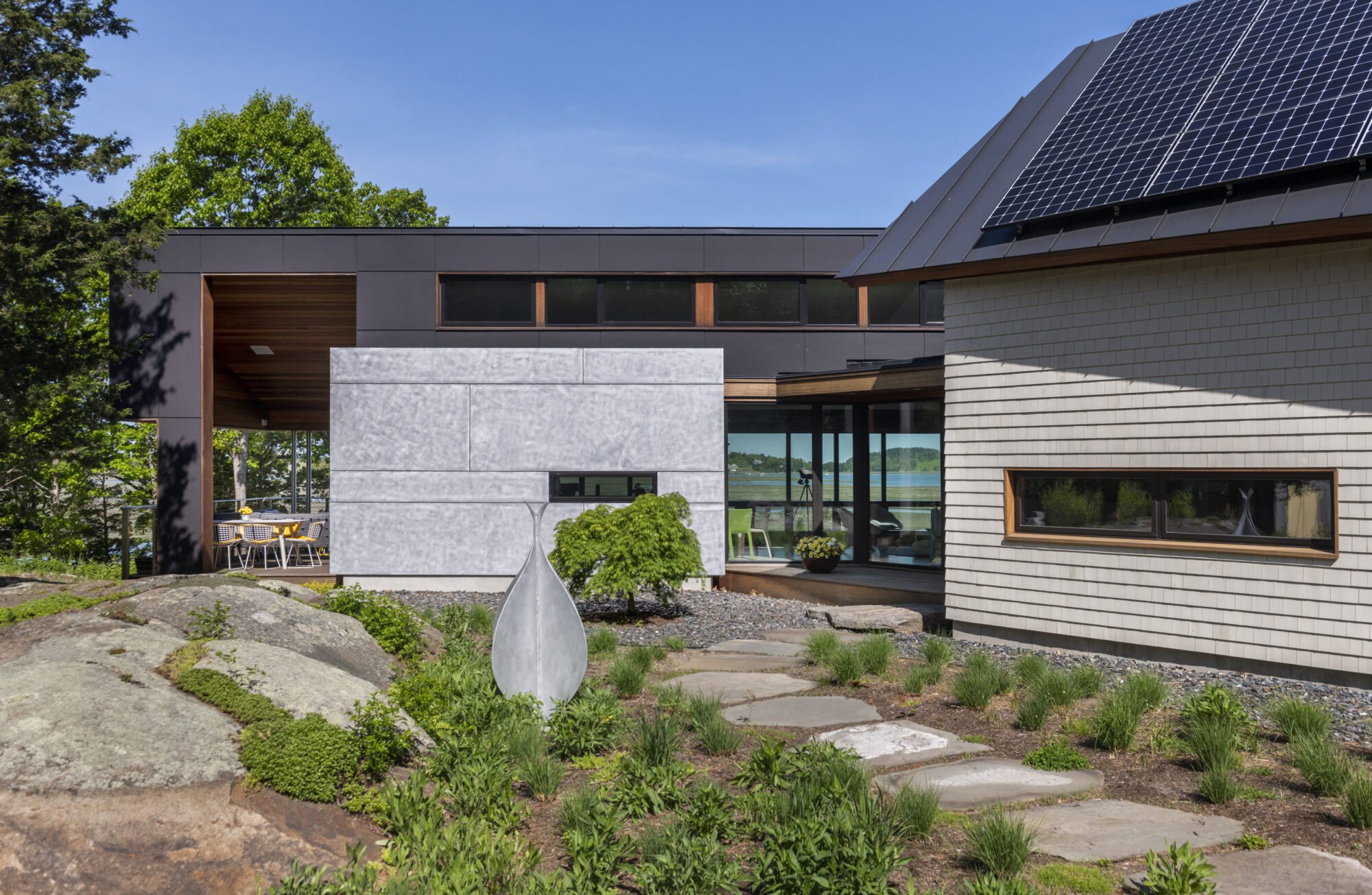
A portion of the house orients directly south to maximize rooftop solar array performance, balancing this technical requirement against the northwest views toward Essex Bay that motivated the site selection. Sizing calculations for the solar array required coordinating building loads, vehicle charging patterns, and available roof area during early design phases to produce a rooftop array that generates sufficient power to operate the home, charge two electric vehicles, and contribute surplus energy to the grid.
Building-integrated solar formed part of the architectural composition from initial concepts rather than being added after design completion. This early integration allowed designers to coordinate roof pitch, orientation, and structural systems to optimize array performance while maintaining coherent architectural expression. The approach demonstrates how renewable energy systems achieve better performance and aesthetic results when incorporated during schematic design rather than retrofitted onto completed building forms.
Passive Solar Design Strategies for Modern Sustainable Architecture
Clerestory windows positioned to capture winter southern light provide passive solar benefits that reduce heating loads while maintaining privacy and preserving primary views toward the water. High windows bring warm sunlight deep into interior living spaces, leveraging solar heat gain during winter months. This passive strategy reduces total energy demand, making net-positive status easier to achieve. The relationship between passive design and system sizing proves critical: buildings with lower baseline energy needs require smaller, less expensive active systems to reach high performance thresholds.
Super-Insulation and Building Envelope Performance
Advanced insulation technology throughout walls, roof, and foundation creates a high-performance building envelope that minimizes heat transfer. Heavily insulated window systems withstand coastal weather while limiting thermal losses, their performance specifications balanced against the need for large glazing areas to capture water views. A tight, well-insulated envelope reduces overall energy needs for heating and cooling, directly affecting the feasibility of net-positive performance.
The relationship between envelope performance and net-positive achievement follows straightforward logic: reduced energy demand requires less renewable generation to exceed consumption. Every thermal improvement in the building envelope allows either smaller solar arrays or greater surplus production. This connection makes super-insulation not merely an energy conservation measure but a fundamental enabler of net-positive status, particularly in coastal climates with significant heating and cooling loads.
Solar Panels as Design Enhancement, Not Detraction
Rethinking Visual Impact
The design team approached rooftop solar arrays as intentional architectural features rather than necessary compromises to be minimized or hidden. This perspective shifts the question from 'how do we conceal the technology' to 'how does renewable energy infrastructure contribute to architectural expression.' When sustainability features integrate honestly into building composition, they can enhance rather than detract from aesthetic qualities.
The notion that technology must remain invisible to be acceptable limits design possibilities and often results in less effective systems. Solar arrays positioned for optimal performance may occupy prominent roof locations, but this visibility communicates values and priorities rather than representing aesthetic failure. The Essex Bay House demonstrates that honest expression of sustainability features creates visually compelling architecture when integrated from initial design stages.
Early-Stage Sustainable Design
Incorporating solar technology into initial design concepts rather than retrofitting it onto completed building forms leads to more elegant, effective solutions. Roof pitch, orientation, and structural design were optimized for array performance from the beginning, producing significant energy benefits while maintaining architectural coherence. The aesthetic and functional benefits of planning for renewable systems from project outset demonstrate why sustainability considerations belong in schematic design rather than being deferred to later phases when options narrow and integration becomes more difficult.
Holistic Environmental Stewardship in Gloucester, MA
Native Plant Landscapes and Water Conservation
Collaboration with landscape architect Lolly Gibson produced native plant designs that integrate existing rock outcroppings with low-water-usage species adapted to coastal conditions. Drought-resistant selections eliminate irrigation requirements once established, reducing water consumption while providing habitat value for local wildlife. These landscape choices complement the building's energy performance goals by extending sustainability considerations beyond the structure itself to encompass the entire site.
Native plantings serve multiple environmental functions simultaneously: they require minimal maintenance inputs, support local ecology, manage water runoff, and provide visual screening that enhances privacy. This multiplicity demonstrates how landscape decisions can advance several project objectives at once when selected strategically.
Water Runoff Management and Low-Impact Development
The landscape design manages water runoff through strategies that protect the adjacent wetland environment while preventing erosion and maintaining site stability. Native plant root systems facilitate natural water absorption, while rock gardens and permeable surfaces reduce runoff volume and velocity. These techniques align with low-impact development principles that emphasize infiltration over collection and conveyance.
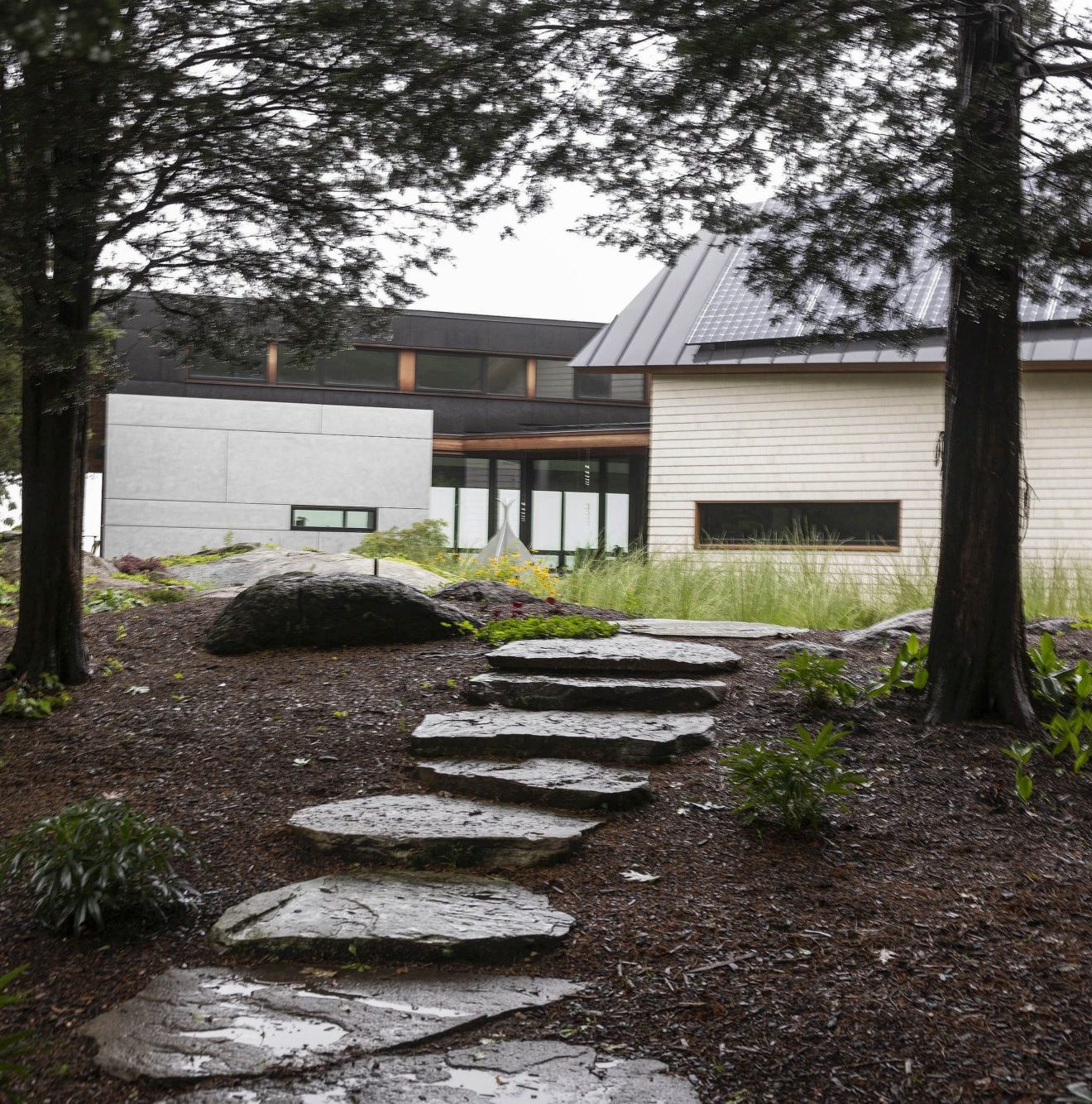
Water quality protection in sensitive coastal environments requires careful attention to how precipitation moves across and off sites. The design channels water through vegetated areas where natural filtration occurs before it reaches protected wetlands, maintaining the hydrological patterns that support ecosystem functions. Site design and landscape architecture emerge as crucial components of environmental stewardship in wetland contexts, their contributions as significant as building systems in determining overall project impacts.
Contemporary Sustainable Design Material Selection
Material selections prioritized longevity and minimal maintenance requirements to reduce lifecycle environmental impacts beyond operational energy use. Balancing upfront affordability with long-term durability ensures that materials perform well throughout their service lives without requiring frequent replacement. This lifecycle perspective recognizes that embodied energy in construction materials and the environmental costs of maintenance and replacement contribute to total project impacts alongside operational energy consumption.
The Economics of Net-Positive Design
Debunking the Cost Myth
The perception that energy-saving technologies carry prohibitive costs persists despite considerable evidence to the contrary. For the Essex Bay House, the clients and engineering team determined that upfront costs for advanced energy features represented less than three percent of total project costs, with a payback period under seven years. This calculation considers both direct utility savings and indirect benefits like enhanced comfort and reduced maintenance requirements.
Upfront investment in sustainability provides immediate comfort benefits, including more consistent temperatures, better air quality, quieter interiors, alongside long-term financial returns. These combined advantages make high-performance design economically rational even before considering environmental benefits or future energy price increases. The cost premium for net-positive architecture proves modest when systems integrate during initial design rather than being retrofitted, demonstrating that performance goals and budget constraints can align when addressed from project inception.
Working With Wetlands Conservation Regulations
The narrative that conservation regulations create unfair hardships for property owners deserves examination against actual project outcomes. For the Essex Bay House, working within wetland regulations enhanced design quality while reducing costs compared to less constrained alternatives. Required setbacks influenced building orientation that optimized solar performance, while restrictions on site disturbance limited expensive excavation and grading work.
The project demonstrates that environmental protection requirements and economic feasibility align more often than conventional wisdom suggests. Reframing regulatory constraints as creative opportunities shifts perspective from what cannot be done to what opportunities exist within established parameters. This mindset produces better outcomes precisely because it treats limitations as frameworks that focus attention on site-specific conditions and strategic priorities rather than allowing unlimited options that can lead to less disciplined design approaches.
Long-Term Value Creation in Modern Sustainable Architecture
Energy independence and reduced utility costs provide ongoing financial benefits that compound over building lifespans. Protection against future energy price increases becomes increasingly valuable as fossil fuel costs fluctuate and carbon pricing mechanisms potentially emerge. Enhanced property values through high-performance certification and advanced systems create competitive advantages in real estate markets where sustainability consciousness continues growing. Net-positive homes represent not just reduced operating costs but future-proof architecture positioned to maintain value as building performance standards evolve and energy costs rise.
Balancing Technology and Environmental Protection
Discussions about building in sensitive areas frequently cite concerns that advanced technology systems might conflict with environmental protection. This assumption holds that high-performance mechanical and electrical systems require intensive site work, complex infrastructure, or construction activities incompatible with wetland protection. The Essex Bay House challenges this perception by demonstrating that technology and ecosystem stewardship represent complementary rather than competing objectives.
Solar arrays, advanced insulation, and high-performance HVAC systems integrate into wetland settings without requiring exceptional site disturbance or infrastructure development. The construction activities necessary for net-positive performance differ minimally from conventional building methods, while the operational benefits provide environmental advantages that extend beyond site boundaries:
- Reduced energy consumption through integrated high-performance systems
- Eliminated fossil fuel combustion via solar energy generation
- Minimal maintenance requirements that reduce long-term site impact
- When selected and integrated thoughtfully, technology can further environmental protection instead of impeding conservation goals.
Resolution Through Integrated Design
Early collaboration between architects, engineers, landscape architects, and conservation officials established frameworks where building performance, site ecology, and regulatory requirements could advance together. Systems thinking (the practice of understanding how these elements interconnect rather than treating them as separate concerns) enabled solutions that satisfied all requirements without forcing compromises.
The most significant challenge proved conceptual rather than technical: shifting mindsets about what remains possible within environmental constraints. Once the team reframed wetland regulations as design opportunities rather than obstacles, technical solutions emerged readily.
A Model for Future Coastal Development in North Shore Massachusetts
Lessons in Responsible High-Performance Design
The Essex Bay House establishes that contemporary aesthetics, performance, and environmental stewardship can coexist without requiring trade-offs. Working with natural features and regulatory requirements produced superior architecture at lower cost than less constrained approaches might have achieved. This outcome challenges conventional assumptions about sustainable design affordability and the supposed burdens of environmental regulations.
Key insights from the project include:
- Net-positive performance remains achievable within tight budgets when prioritized from project inception
- Wetland regulations can enhance rather than hinder design quality and economic outcomes
- Technology and ecosystem protection advance together through integrated design processes
- Early collaboration between all stakeholders prevents conflicts and produces superior solutions
These lessons set new standards for what remains achievable in sensitive coastal environments, demonstrating that high performance and environmental responsibility represent compatible objectives, not competing priorities.
From Conservation to Contribution
The sustainability conversation has traditionally focused on minimizing harm: reducing energy consumption, limiting site disturbance, decreasing material waste. Net-positive architecture moves beyond this conservation framework toward active contribution, where buildings generate surplus energy that benefits broader infrastructure systems while occupying sites in ways that protect or even enhance ecosystem functions.
This shift from neutral impact to positive contribution is more than a semantic distinction. Architecture that gives back to energy grids and natural ecosystems establishes different relationships with infrastructure and landscape than buildings that merely mitigate damage. The Essex Bay House designed by RUHL | JAHNES provides a precedent for the next generation of coastal architecture: homes that actively improve their environmental contexts rather than simply minimizing degradation. When buildings contribute to energy systems while protecting sensitive wetlands, they demonstrate that human habitation and ecological health can advance together through thoughtful design that integrates performance goals, regulatory requirements, and site stewardship from the beginning.